
Is Canada facing a renewed wave of inflation, and how will the Bank of Canada respond? To understand where monetary policy is heading, we need to look at the macroeconomic indicators leading the market: energy prices, bond yields, and central bank policy signals.
Lessons from 2022: Energy Prices, Bond Yields, and CPI
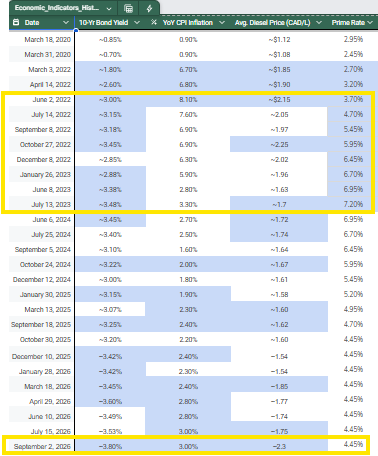
The last time Canada’s 10-year bond yield crossed 3.00% while diesel prices surpassed $2.00/L (back in 2022), CPI inflation surged to a peak of 8.10%. In response, the Bank of Canada aggressively tightened monetary policy, eventually driving the Prime Interest Rate up to 7.20%.
While the geopolitical and economic conditions of 2022 differ from where we stand today, historical patterns show that rising energy costs directly fuel broader cost-push inflation across the economy.
What the US Fed Projections Signal for Energy and Inflation
The US Federal Reserve recently raised its policy rate by 0.25%, citing persistent inflationary pressures. However, the Fed’s economic projections also suggest that inflation could fall back to its 2.00% target by late 2027.
The Fed assumes that energy price volatility caused by global geopolitical conflicts—including tension in Iran and the Russia-Ukraine war—will eventually subside. Crucially, the projections do not state that energy prices will drop significantly; rather, they indicate that the initial shock of higher prices will dissipate.
Reading between the lines, these economic projections reveal four critical trends:
- Normalized Energy Costs: High diesel and fuel prices are becoming the new structural baseline.
- Upward Price Adjustments: Transportation and consumer food prices will adjust upward to absorb ongoing energy expenses.
- Active Interest Rate Management: Central banks will maintain higher policy rates for longer to keep demand in check.
- Target Stabilization by 2027: Inflation is expected to settle near 2.00% only after energy market volatility stabilizes.
How Will the Bank of Canada Respond?
The Bank of Canada is likely to align closely with the Fed’s stance. Anticipate rate hikes at upcoming policy announcements, with potential rate increases on October 28th and December 9th.
Because rising energy prices remain the primary inflation catalyst, containment depends on whether transport and food price increases spill over into broader supply chains. If secondary price impacts remain contained, Canada’s core inflation rate may stay below the 3.50% threshold.
Variable vs. Fixed Mortgages: Managing Interest Rate Risk
If central banks successfully contain these inflation risks, holding a variable-rate mortgage can still be a viable long-term strategy. However, given the recent uptick in bond yields, energy prices, and CPI, the safety margin for variable rates has narrowed—making a variable-rate mortgage a noticeably higher-risk proposition today.
What Is Your Strategy?
Are you opting for the stability of a fixed mortgage, or holding out with a variable rate in hopes of eventual rate cuts? Leave your thoughts in the comments below or contact our team to discuss your real estate and financing strategy.